The Best Walks In Devon in Spring
Spring is the perfect time to brush the cobwebs off your walking boots and hit Devon’s glorious hiking trails.
The county’s streams, rivers and waterfalls are full to the brim after winter’s heavy rains (may as well reap some benefits from January’s relentless rain!).
Woodlands are bursting with greenery, birds flock back to nature reserves, and clifftops are resplendent with bluebells and daffodils.
Best of all, you’ll miss the summer crowds that soon descend on Devon’s best hiking trails, making spring one of the best seasons for a quiet coastal or countryside stroll.
From the Teign Gorge to the Otter Estuary, here are the best spring walks in Devon.
1. Teign Gorge to Fingle Bridge
The walk through Teign Gorge to Fingle Bridge is one of Devon’s most atmospheric spring hikes. Following the River Teign as it cuts along the eastern edge of Dartmoor’s moody moors, this circular walk takes you for around 4 miles from Castle Drogo to Fingle Bridge (and back again).
You’ll start beneath the granite walls of Castle Drogo. Dating to the early 20th century, this mock medieval stronghold was technically the last castle built in England. From here, the path descends into dense woodlands, where you’ll follow a river gorge that’s in full spring bloom.
Bluebells line woodland pathways, and as you cross the 17th-century stone spans of Fingle Bridge, the River Teign flows fast beneath you.
Click here for my full Dartmoor travel guide.
2. Dunsford Nature Reserve
On the eastern edge of Dartmoor, a short drive from Exeter’s urban sprawl, you can find one of the best places in Devon for a spring stroll.
Locally, Dunsford Nature Reserve is almost revered for its springtime daffodils. Arrayed along the banks of the River Teign, a gentle, circular walk leads you through wooded terrain that, between February and May, is blanketed in a bright sheen of yellow flowers.
There are several miles of easy walking to be had within Dunsford Nature Reserve, following marked pathways on fairly flat terrain. Allow 1.5 hours to enjoy the spring scenery!
3. Slapton Sands and Slapton Ley

For history lovers, Slapton Sands is one of Devon’s most intriguing spots for a springtime walk. Head to the county’s southern shores, and you’ll find a sandy coastline reminiscent of Normandy’s beaches.
That’s why, in 1943, Slapton Sands became a training ground for Allied forces preparing to invade occupied France. But training ended in tragedy when the German Navy attacked Allied troops rehearsing for the later D-Day landings. Today, an old Sherman tank stands in Torcross as a memorial.

We recommend heading to Torcross Car Park, next to the Exercise Tiger Memorial, from where you’ll follow the South West Coast Path north along Slapton Sands.
On one side, you’ll have a gorgeous sandy beach, on the other, you’ll see migratory birds congregating around the waters of Slapton Ley, one of Devon’s largest freshwater lakes.
Loop inland to Slapton Ley Nature Reserve, head to the pub in Slapton village for lunch, then retrace your steps back to Torcross for a 4-5 mile-long hike.
See my full guide to Slapton Sands and Slapton Ley here.
4. Budleigh Salterton to Otterton
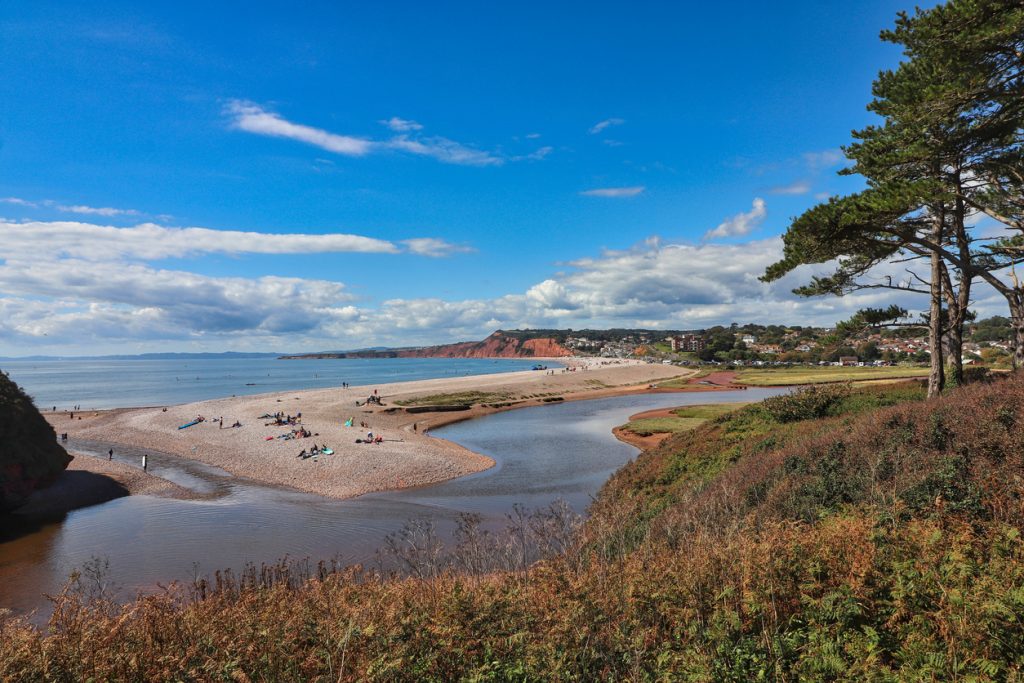
Starting in Budleigh Salterton, this wonderful spring walk navigates the tidal banks of the Otter Estuary inland to Otterton. Your walk begins on the Jurassic Coast, but you’ll soon leave Budleigh Salterton’s pebble beach behind as you stroll through the Otter Estuary Nature Reserve.
Recently redeveloped paths lead you past mudflats and bird-watching hides, where you might spot avocets and kingfishers.
As you near Otterton, you could even be in with a chance of seeing a beaver, as the river here is one of the few places in the country known to be inhabited by these aquatic mammals.
This riverside walk stretches for around 2.5 miles from Budleigh Salterton to Otterton, where you can enjoy some well-earned refreshments at the village’s centuries-old watermill-turned-cafe.
Head back the same way you arrived, or make a day of it and hike onwards to Ladram Bay and back to Budleigh Salterton along the South West Coast Path.
This hike also takes in Ladram Bay – take a look at my full guide.
5. Plymouth Waterfront Walkway

Let’s be honest, Plymouth is bleak in winter. But as soon as the sun starts shining, Britain’s ‘Ocean City’ transforms into a happening buzz of springtime activity as boats fill the harbour and pubs open their gardens.
For something a little different this spring, we suggest tackling the Plymouth Waterfront Walkway, an overlooked stretch of the South West Coast Path tracing the urban edges of Plymouth Sound.
The route starts at Admiral’s Hard, from where the Cremyll Ferry departs, before leading you through Royal William Yard, along Plymouth Hoe and into the Barbican.
Enjoy sweeping views of Plymouth Sound while digging into the city’s fascinating maritime history. This section of the waterfront walkway is around 4 miles each way, with plenty of pubs to stop at on the way.
6. Meldon Reservoir to High Willhayes
One of Dartmoor’s more exposed walks, the spring season is the perfect chance to tackle the long hike from Meldon Reservoir to High Willhayes.
This hike takes you from the edge of the moor itself, via Yes Tor, to the highest point on Dartmoor. At 621 metres, you’ll have glorious views on a sunny day, but be warned, this isn’t a stroll in the park, but a proper Dartmoor hike.
Start at Meldon Reservoir, before steadily climbing uphill to the top of High Willhayes, and the 3-mile walk to the summit should take around 2.5 hours each way.
You could be crossing parts of the MOD’s live fire range, depending on your exact route. Before setting off, you’ll need to check firing times on the government’s website.
7. Sidmouth to Seaton

In 2007, a Canadian investment banker named Keith Owen left around £2.3 million to Sidmouth in his will. His instructions were to support ambitious community projects, and one of those ideas was to plant vast numbers of daffodil bulbs across the area, transforming open spaces into a seasonal display.
Hundreds of thousands of daffodils were planted in and around Sidmouth, and in springtime, the valley and surrounding hillsides are bright yellow in colour.
Tackle the longer coastal walk from Sidmouth to Seaton, and along your 14-mile hike, you’ll have ample opportunity to enjoy the daffodil-laden landscapes.
This hike follows a dramatic stretch of the Jurassic Coast, typically taking 5–7 hours, with several sustained climbs and descents along the cliffs.
After walking along the red sandstone cliffs of Ladram Bay, you can take a break on Branscombe Beach and enjoy a cold beer in Beer before your arrival in Seaton. You can of course, stop your walk in any of the previous villages, as Sidmouth to Seaton is quite a long way (10 miles/ 16 km).
8. Tarr Steps – over the border in Somserset!

Tarr Steps, an ancient ‘clapper’ bridge constructed long ago from large slabs of granite, is one of Exmoor’s most recognisable landmarks. And spring is the best time to visit.
You’ll find Tarr Steps, which could be as much as 4000 years old, spanning the River Barle within Exmoor National Park. Like most of the park, the bridge is actually in Somerset, but this walk is easily accessible from northeast Devon!
During winter, the steps are often uncrossable after heavy rains, but by springtime, the river’s running lower, and the surrounding woodland brims with life.
Start your walk from the car park by the Tarr Farm Inn next to the River Barle. The steps themselves are just a short stroll away. Gentle walking paths then follow the riverbank, making this the ideal setting for a short spring stroll!