How to find the South West’s secret rainforests
It’s like a scene from Jurassic Park. Surrounded by tall ferns dripping with rainwater, it’s strangely humid as I walk through a rainforest glistening emerald green with moss and lichen. But no, I’m not in Borneo or anywhere near the Amazon; I’m in Ausewell Woods, a rare fragment of ancient, temperate rainforest in Devon.
Yes, Britain has rainforests. And given how much we love to complain about rainy days here in the United Kingdom, that should really be no surprise.
Indeed, the British Isles were once covered in vast swathes of temperate rainforests. This unique ecosystem thrived on the high rainfall deposited on the west coast by Atlantic storms.
For centuries, though, Britain’s rainforests have been in retreat, and it’s estimated that just 1% of them remain today.
Many of these dwindling patches are found in the South West. Isolated fragments cling on in Dartmoor and along the rainswept Cornish coastline. Here’s how you can see the best of them.
What are ‘temperate rainforests’?

A temperate rainforest is a type of rare woodland that thrives in regions of high rainfall, high humidity and mild winters.
Unlike tropical rainforests found on the equator, they are shaped by cooler, oceanic climates, and home to dense cloaks of lichen, mosses and ferns which typically cover oak trees.
In Britain, temperate rainforests are primarily found along the western seaboard, where the prevailing winds off the Atlantic deposit vast quantities of rain throughout the year. The Gulf Stream keeps temperatures relatively stable, preventing the long freezes that would otherwise kill moisture-loving plants.
South-west England, western Wales and the west coast of Scotland all have pockets of this habitat, often in deep valleys, along estuaries and on steep slopes where clearance for farming was impractical.
Although they now survive only as fragments, these British rainforests are part of a much larger ecological band stretching from Norway down to northern Spain – all of which, unfortunately, is in danger of extinction.
The best temperate rainforests in the South West
The richest surviving fragments of temperate rainforest are found in steep-sided valleys and remote river gorges, especially in Devon and Cornwall.
Dartmoor’s lower slopes hide ancient woodland along the River Dart and the Bovey, while in Cornwall, the Helford River and parts of the Fal estuary support lush, moisture-laden woods.
In parts of Exmoor, particularly the coastal combes, woodland descends almost to the shore, fed by spray and mist from the Bristol Channel.
These forests are not vast. Many are less than a few square miles, remnants of what once covered far greater areas in the Atlantic fringe of Europe.
These fragments of temperate rainforest are incredibly vulnerable, so it’s important to exercise caution when attempting to visit them.
Some, like Wistman’s Wood in Dartmoor, are closed off to the public to protect delicate ecosystems.
Rainforests to visit in the South West
Ausewell Wood, Dartmoor, Devon

Ausewell Wood (on the south-eastern edge of Dartmoor near Ashburton) is one of the largest surviving fragments of temperate rainforest in Devon. The woodland stretches across steep valley slopes above the River Dart and its canopy is dominated by oak and birch.
What makes Ausewell so significant is its extraordinary diversity of lichens and mosses, many of which are rare or declining elsewhere in Europe.
The Woodland Trust and the National Trust jointly manage the site, focusing on restoring natural processes, tackling invasive species and allowing the rainforest to regenerate after centuries of exploitation for timber and charcoal.
For visitors, Ausewell Wood offers a glimpse of what much of Devon’s river valleys might once have looked like. The wood is easiest to reach from Ashburton, just off the A38 and towards Buckland-in-the-Moor. There’s a small car park with walking trails leading into the woods. Ongoing conservation efforts mean that access can sometimes be limited.
Here’s my full guide to Dartmoor National Park.
The Dart Valley Trail, Devon
The Dart Valley Trail winds its way through the steep-sided gorges between Dartmeet and Buckfastleigh, allowing access to some of the most impressive temperate rainforest in southern Britain.
Ancient oak and birch cling to the valley slopes, their trunks draped with mosses, lichens and liverworts that thrive in the constant damp rising from the River Dart.
In places, the woodland is so thick with epiphytes that almost every surface is green, a reminder of the rainforest conditions that once stretched across much of the Atlantic seaboard.
The 27-mile-long Dart Valley Trail, which links Totnes and Dartmouth, passes through stretches of ancient woodland along the river. The upper valley can be reached from the car parks at Dartmeet or New Bridge.
Bovey Valley Woods, Devon
Bovey Valley Woods sits on the eastern edge of Dartmoor, near Lustleigh.
The woods are dominated by oak, birch and hazel, with a dense ground layer of ferns and mosses. High humidity from the River Bovey and its tributaries creates the ideal conditions for epiphytes: rare lichens cling to tree trunks and rocks.
Access is straightforward but best undertaken on foot. There are car parks at Pullabrook (near Bovey Tracey) and further away at Houndtor or Bovey Tracey, with public footpaths connecting through the valley to Lustleigh Cleave.
Becky Falls, Devon

Becky Falls is located on the eastern edge of Dartmoor near Bovey Tracey. The falls themselves tumble over huge granite boulders in a steep wooded valley, and the surrounding ancient oak and birch woodland is carpeted with mosses, lichens and ferns that flourish in the constant spray and high humidity.
The ancient woodland site and waterfall have long been a place of human interest. It became a popular visitor attraction in the nineteenth century, when Dartmoor began to draw tourists seeking romantic scenery, and today it remains both a natural wonder and a protected habitat.
Access to Becky Falls is via a managed visitor centre on the road between Bovey Tracey and Manaton. There is parking on site, and a network of colour-coded trails provides routes of varying difficulty, including walks along the river and through dense woodland.
See my full guide to Becky Falls here.
Lydford Gorge, Devon

Lydford Gorge, which is located on the western edge of Dartmoor, is not only the deepest river gorge in southern England, but one of the most atmospheric surviving examples of Britain’s temperate rainforest.
The steep valley walls were carved by the River Lyd and shelter mosses, oak trees, liverworts and ferns. Waterfalls and spray add to the humidity, and every rock and tree trunk seems to glisten green.
The gorge is managed by the National Trust, which provides facilities at both the top and bottom entrances. Visitors can explore a series of well-marked circular trails, the most famous leading to the White Lady Waterfall and the Devil’s Cauldron.
Access is via the village of Lydford, on the A386 between Tavistock and Okehampton. There is parking at each entrance, but be warned that paths are steep, narrow and often slippery.
See my full guide to Lydford Gorge here.
Helford River and Frenchman’s Creek, Cornwall
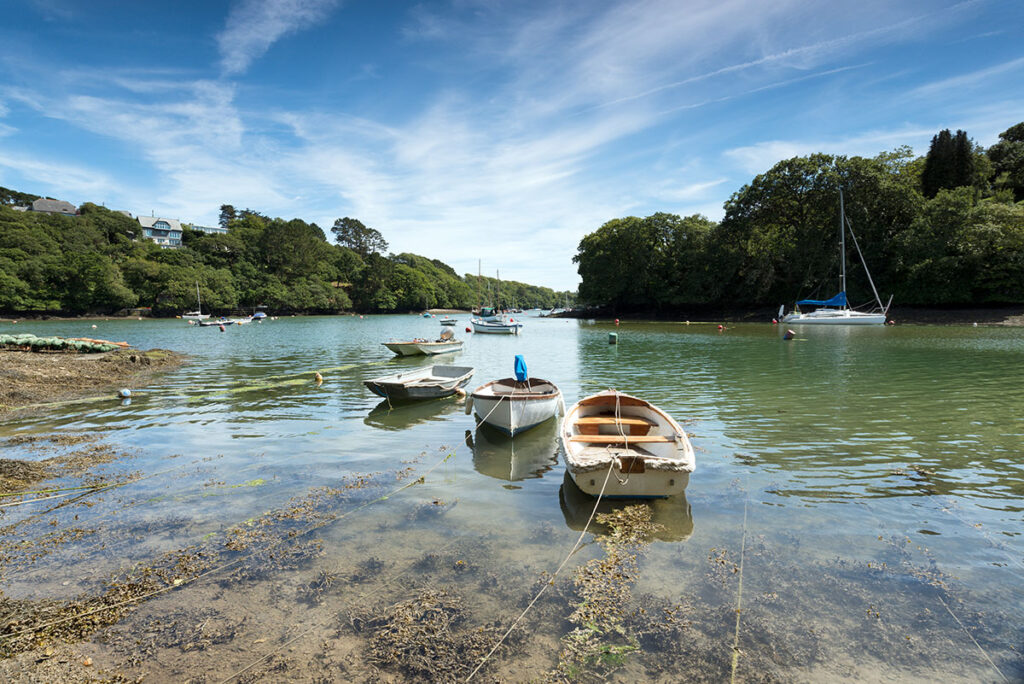
Frenchman’s Creek, on the Helford River in southern Cornwall, is a tidal inlet lined by ancient oak woodland. The steep banks shelter the woods from wind, creating a humid microclimate where mosses, lichens and ferns grow thickly on tree trunks and fallen branches.
The mingling of salt air from the estuary with freshwater seepage gives the area a distinctive ecology, supporting species that thrive only in such damp and sheltered conditions. The creek is also steeped in cultural history: it inspired Daphne du Maurier’s 1941 novel Frenchman’s Creek, which drew on the long association of the Helford River with smuggling and maritime trade.
Frenchman’s Creek is best explored on foot. The South West Coast Path and local permissive trails loop around the creek, starting from Helford Village, where limited parking is available.
Cabilla Woods, Cornwall
Cabilla Woods, set in the secluded Warleggan Valley on the edge of Bodmin Moor, is the focus of an ambitious rewilding project. Ancient oaks line the valley slopes above the River Warleggan, their trunks smothered in mosses and lichens that thrive in the region’s constant damp.
For centuries, the woods were shaped by human use, from medieval charcoal production to twentieth-century conifer planting. Today, however, the priority is restoration. The rewilding project, led by the charity Cabilla Cornwall, is gradually removing non-native trees, allowing natural regeneration, and encouraging the return of wildlife.
It also provides a space for people to reconnect with this rare habitat through retreats and guided experiences. Guests can stay in off-grid cabins, take part in forest bathing or join walks that explore the ecology and history of Britain’s rainforests.
Trelissick, Cornwall
Located on a wooded peninsula between the Fal and Truro rivers in south Cornwall, Trelissick offers one of the most accessible glimpses of Britain’s surviving temperate rainforest.
The estate is now managed by the National Trust and combines landscaped gardens with extensive stretches of ancient oak woodland along the steep banks of the Carrick Roads.
Visitors can explore the estate on a network of well-marked trails, many descending to the river’s edge.
Parking is available at the National Trust car park, and in summer the King Harry Ferry links Trelissick to the Roseland Peninsula, offering a car-free approach to these ancient woods.
Watersmeet and the East Lyn Valley, Exmoor
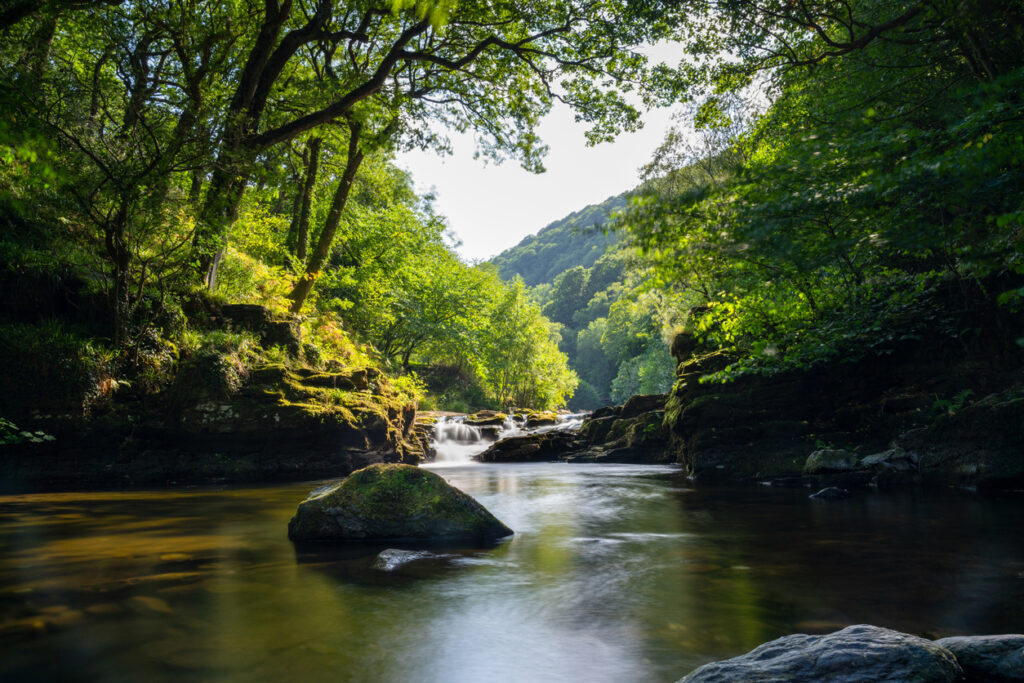
Watersmeet is one of the most dramatic places to experience Britain’s temperate rainforest. Located two miles from Lynmouth in Exmoor National Park, here, the East Lyn River crashes through a steep, wooded gorge, fed by countless streams that keep the air perpetually humid.
The woodlands here are classified as ancient, their survival owing much to the valley’s steep terrain, which made large-scale clearance impossible.
In the nineteenth century, the site became a popular destination for Victorian tourists, drawn by the romantic combination of waterfalls, wild woodland and deep ravines.
A fishing lodge built in that period now serves as a National Trust tea room, preserving its heritage as a place of retreat as well as of ecological importance.
Horner Wood, Exmoor, Somerset
Horner Wood is located on the north-eastern edge of Exmoor near Porlock and is one of the largest and most continuous tracts of ancient oak woodland in England. It forms part of Exmoor’s National Nature Reserve and is a classic example of Britain’s temperate rainforest.
The main entrance is from Webber’s Post above Porlock, where there is a car park and information boards. A network of trails leads into the valley, ranging from gentle riverside walks to longer climbs into the higher combes.
Help to protect the South West’s ancient temperate rainforests
Visitors to the south-west’s rainforests have an important role to play in ensuring these rare habitats survive. Unlike ordinary woodland, temperate rainforests are exceptionally fragile; plants are slow-growing and easily damaged by trampling.
Remember to keep to established paths, avoid clambering over boulders or fallen trunks and watch out for conservation and rewilding areas which may be out of bounds.
Many of the south-west’s rainforest fragments, such as Ausewell Wood or Cabilla Woods, are managed by charities and local trusts that rely on donations, volunteering and membership fees.
By contributing financially or giving time to habitat restoration projects, you can help remove invasive species, plant native trees and maintain access routes that minimise ecological harm.
Visiting mindfully, leaving no litter and resisting the temptation to pick plants or fungi will help you safeguard the south-west’s surviving rainforests for future generations to enjoy.