Dartmoor is now more accessible than ever – here’s why
Dartmoor’s moody moors hold thousand years of human and natural history within their granite tors. Home to misty fells, temperate rainforests dripping with lichen and ferns, and ancient stone circles wreathed in legends, like many travellers before (and many more to come), I’ve always been astounded by the South West’s most impressive national park.
Dartmoor’s remoteness was always its biggest draw, but winding country lanes and narrow roads – often blocked with mud-smeared tractors or flocks of Greyface Dartmoor sheep – always made it a difficult place to approach by car. In summer, car parks are packed out, and in winter, the first snow falls bring hordes of tourists to the moors.
Since 2021, however, Dartmoor’s isolated tors have become more accessible than ever, with the reopening of the old Dartmoor Line to Okehampton. You no longer need brave lengthy queues on the Devon Expressway or search high and low for the last parking spot. Instead, hikers can enjoy a leisurely train ride to the edge of Dartmoor National Park, before setting off on foot in search of standing stones and spectacular vistas.
If you’re planning a trip to this glorious national park, here’s how to visit Dartmoor by train.
The Dartmoor Line

The Dartmoor Line is a restored railway link connecting Exeter to Okehampton. Operated by Great Western Railway, the line runs for approximately 15 miles to the northern edge of Dartmoor National Park in Devon.
The railway link to Okehampton first opened in 1871 as part of London and South Western Railway’s westward expansion into Devon and Cornwall. It was originally a key stop on the route from Exeter to Plymouth, and for decades, the line carried passengers, holidaymakers and freight. During the Second World War, the line even carried military equipment and troops to the Royal Navy docks in Plymouth.
The post-war years, however, brought decline. Rising car ownership and the infamous Beeching Report of the 1960s sealed its fate. Regular passenger services to Okehampton ended in 1972, though occasional summer Sunday trains continued, keeping the line technically alive. Freight traffic to Meldon Quarry, a few miles from Okehampton, persisted into the early 2000s, maintaining part of the route into the modern era.
The loss of passenger services were keenly felt on Dartmoor, and after their closure, community groups campaigned tirelessly for the line’s reinstatement. They argued that the line was a lifeline in rural Devon, and provided an alternative rail route to Plymouth if storms cut the coastal railway at Dawlish. Their case gained momentum in the 2010s, especially after the Dawlish sea wall was breached in 2014.
In November 2021, the line reopened for daily passenger services, the first in Britain to return under the government’s ‘Restoring Your Railway’ programme (a programme which was then cut in 2024). Operated by Great Western Railway, it now runs roughly every hour between Exeter and Okehampton, reconnecting Dartmoor’s northern edge with the national network after nearly half a century of isolation.
From Exeter to Okehampton

Exeter is the principal departure point for passengers visiting Dartmoor by rail. Both Exeter St Davids and Exeter Central are served by frequent services from London Paddington, London Waterloo, Bristol and Birmingham.
The Dartmoor Line primarily departs from Exeter St Davids, however, some services also stop at Exeter Central. The journey takes approximately 40 minutes, with one stop en route at Crediton. Departures are roughly every hour, seven days a week.
The earliest departure from Exeter is around 06.30. The last departure back from Okehampton is at 20.30 (timetables vary however, so check Great Western Railway’s website or app for up to date schedules).
On board, the journey offers glimpses of Devonshire farmland, rolling hills, and river valleys before the landscape begins to rise towards the northern edge of the moor. Trains are modern and accessible, equipped with free Wi-Fi (in theory!), power sockets, and space for wheelchairs and prams.
Fares are affordable by British intercity standards: a day return from Exeter to Okehampton costs £9.20, with Railcard discounts available. Local residents can buy a Devon & Cornwall Railcard for further reductions.
How to visit Dartmoor National Park from Okehampton

Arriving in Okehampton places you right on the northern boundary of Dartmoor National Park. The station, once the hub of a line that extended to Plymouth, has been partly restored to its mid-20th-century appearance, complete with the Bulleid Buffet – a café named after Oliver Bulleid, the Southern Railway’s innovative chief mechanical engineer – and plenty of vintage Great Western Railway holiday posters.
The station itself is just under a mile from Okehampton. It takes around 15-20 minutes to walk (mostly downhill) to the town centre. If you’re here to visit the moors, however, you can follow walking trails directly into the national park as soon as you alight from the train.

Here are some of the best walks from Okehampton station:
Okehampton Castle
Approx 1 mile/25 mins each way.
The simplest walk from Okehampton Station is to the ruins of Okehampton Castle, a distance of around 1 mile which should only take 25 minutes or so. Leaving the station platform, you follow the road downhill into town before walking through Simmons Park.
Passing through its gates, you follow footpaths that run alongside the River Okement, shaded by trees and dotted with gardens and a small bandstand. At the far end of the park the path leads into the town, where signposts guide you towards the castle. A lane called Castle Road runs along the East Okement River, and after a short stroll you arrive at the site itself.
The ruins of Okehampton Castle rise above the riverbank. Managed today by English Heritage, the Norman castle’s grounds include a small exhibition in the gatehouse and paths that loop through the surrounding woodland, making it easy to explore from the station.
See the top things to do in Okehampton here.
Belstone Tor and the Nine Maidens

Approx 5miles/2.5 hours each way.
One of the best walks from Okehampton Station is to Belstone Tor and the Nine Maidens Stone Circle. You can combine a trip onto the moor with a stop in Belstone village, where country pubs offer the perfect place to fuel up part way through the hike.
Leaving Okehampton Station, the most direct way to reach Belstone village is to follow the lane downhill into town and then pass through Simmons Park, keeping to the riverside paths of the West Okement. At the far end of the park you cross under the A30 by a footbridge at Fatherford. This is where the town gives way to open country. Quiet lanes and hedged tracks lead you eastwards, climbing gently between fields towards Belstone village, which lies about three miles from the station.
From here the tors are within easy reach. Passing through the village, you head towards the cattle grid that marks the transition from enclosed farmland to open common. Before climbing to the higher tors, a short detour brings you to the Nine Maidens, a Bronze Age stone circle. Folklore says the stones are maidens punished for dancing on the Sabbath, a legend that echoes the moralising tales attached to prehistoric monuments across Britain.

From the circle, the path continues uphill onto Belstone Tor, where granite outcrops crown the ridge. The climb takes no more than twenty to thirty minutes from the village. The whole walk from Okehampton Station to Belstone Tor is about five miles one way, which makes for a rewarding half-day outing. It is also possible to make a circuit by looping back through the East Okement Valley before rejoining the route near Fatherford, then back to the station.
Yes Tor and High Willhays
Approx 8.5miles/6 hours return trip.
For a more demanding walk, you can tackle the summits of Yes Tor and High Willhays, the latter of which is the highest point in southern England. The full circuit – Okehampton Station to Yes Tor, on to High Willhays, and back via Okehampton Camp – covers about 8.5 miles and takes approximately 6 hours at a steady pace.
The route begins with a steady walk south from the station, past Okehampton Camp, a military training base dating back to the Victorian era. From here a stony track, known as the Tors Road, carries you upwards to Yes Tor, which sits at 619 metres. Reached in about 2 hours from Okehampton Station (roughly 3.5 miles/5.5 km), its outcrop of weathered granite boulders invites a scramble to the top, where the view unrolls in all directions.
A short ridge walk of about 30 minutes leads from Yes Tor to High Willhays, at 621 metres the highest point on the moor and indeed anywhere in England south of the Peak District. It is not a walk to take lightly. The tors lie inside a military firing range, so you must check access before setting out. Conditions can shift quickly, and mist can close in, making navigation difficult even for experienced walkers.
Once you’ve reached the two summits, turn back and hike the same way to return to Okehampton Station.
See my full travel guide to Dartmoor here.
The Granite Way
11 miles each way.
If you’re more of a cycler than a hiker, you’re in luck too. The Dartmoor Line provides convenient access to the Granite Way, an 11-mile long, mostly traffic-free route stretching to Lydford.
Beginning directly at Okehampton Station, the trail follows the course of the old railway westward towards Lydford. Its surface is smooth and well-maintained, making it accessible to families, leisure cyclists, and walkers alike. Bikes can be hired at Okehampton Station, so there is no need to even bring your own on the train.
The first stretch carries you past cuttings and embankments where the railway once ran, before reaching Meldon Viaduct. This Victorian iron bridge strides across the West Okement Valley, and from its deck the view drops steeply to the river below and stretches across wooded slopes to the open moor beyond. A short detour here then brings you to Meldon Reservoir.
Continuing west, the Granite Way threads through the parishes of Sourton and Bridestowe. Old railway architecture remains along the line, with bridges, cuttings, and occasional views of the tors rising to the south.
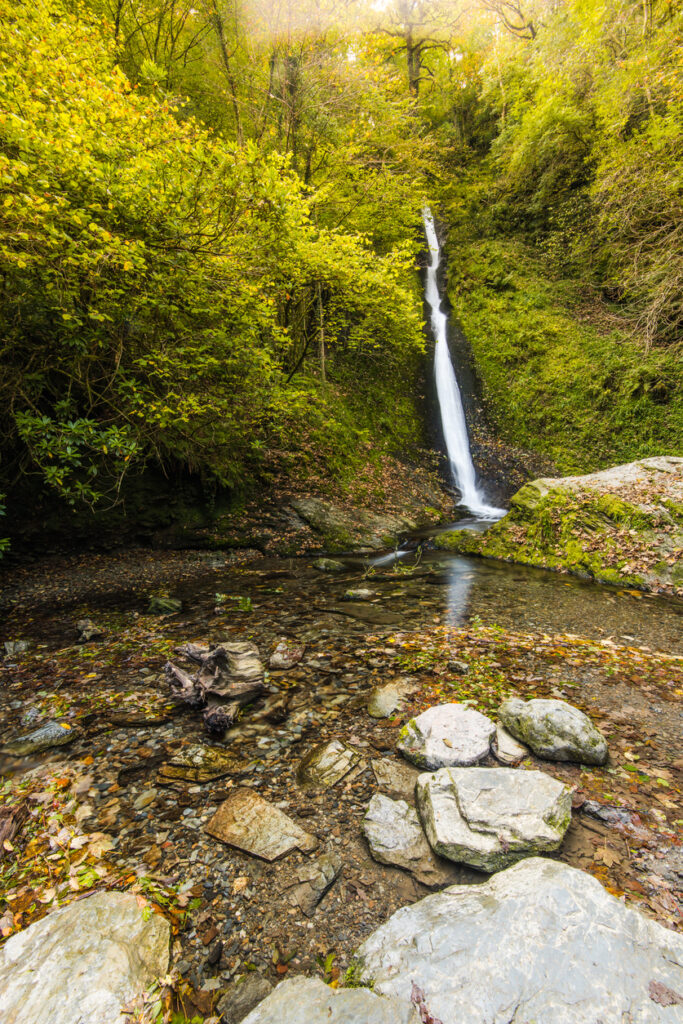
The trail eventually reaches Lydford, eleven miles from Okehampton. Here you can explore the medieval castle, once a notorious prison, or descend into Lydford Gorge, where the River Lyd has carved a dramatic ravine, complete with waterfalls and mossy woodland. From Okehampton to Lydford the ride is likely to take about an hour and a half each way at a leisurely pace.
Where to stay
If you’re making a weekend of it on Dartmoor, there are plenty of accommodation options to consider. There’s even a YHA Hostel located within a converted railway goods shed at the station itself. The hostel offers dormitory beds and private rooms, as well as organised outdoor activities through its sister project, Adventure Okehampton. It is a practical base for those who want affordable lodging with direct access to trails.
In Okehampton town itself, about a mile downhill from the station, there is a wider spread of guesthouses, pubs with rooms, and small hotels. For those who want to immerse themselves more deeply in the moorland environment, wild camping is part of Dartmoor’s cultural identity.
Unlike other national parks in England, Dartmoor has historically allowed people to pitch a small tent for a night on open moorland, provided they follow the “leave no trace” principle. This tradition came under legal challenge in 2023, when a court ruling briefly removed the right to camp without landowner permission.
Following protests and negotiations, the National Park Authority reached an agreement with landowners that reinstated limited areas where wild camping is once again permitted. These zones are marked on maps published by the authority, and it is essential to check them before setting out.
The future of the Dartmoor Line

The reopening of the Dartmoor Line was a significant move for outdoor enthusiasts, improving access to the moors and allowing for car-free travel to this spectacular national park.
The positive future of the Dartmoor Line seems set in granite, too. By 2026, Okehampton is set to gain a new transport interchange (Okehampton Interchange) with a 200-space car park, electric vehicle charging points, and improved bus bays. There is also local ambition to see the remainder of the old route to Tavistock reinstated, which would create a through line between Exeter and Plymouth via the moor.
Visiting Dartmoor by train is now incredibly straightforward. Whether you’re walking into open moorland from Okehampton or cycling the old railbeds to Lydford, the railway offers a dependable and low-impact way to explore one of Britain’s most storied landscapes.