You can find the OLDEST BOOK of English Literature in DEVON!
If I asked you where to find the oldest surviving book of English literature, Exeter might not be your first guess. You might think of the British Library or a university collection where you’d need an appointment to see it.
But the Exeter Book has been in Exeter Cathedral’s care for centuries. And now, you can see it there.
What is the Exeter Book?
The Exeter Book is a manuscript from the 10th century containing an anthology of Old English poems. It’s considered the oldest surviving book of English literature!
There are older records connected with England, but this is a collection of literary writing, made roughly a thousand years ago.
For most of the time it has been at Exeter Cathedral, visitors couldn’t simply walk in and see it. The cathedral had to care for a fragile manuscript while finding a way to display it safely. Its new Treasures Exhibition, housed in the 19th-century Pearson Building, has made that possible.

What else can you see in the exhibition?
The Exeter Book is part of a wider display of objects the cathedral has cared for but previously struggled to show visitors. The Dean of Exeter, the Very Revd Jonathan Greener, explained that it had been almost impossible to put many of these precious items on display in Devon.
Among them is the cathedral’s foundation charter, dating from 1050. There’s also Exon Domesday, an important surviving source for the Great Domesday Book!
You can see England’s only surviving set of medieval wax votives too. These small objects were left as offerings, and it’s unusual that a complete set has lasted to the present day!
Why is it on display now?
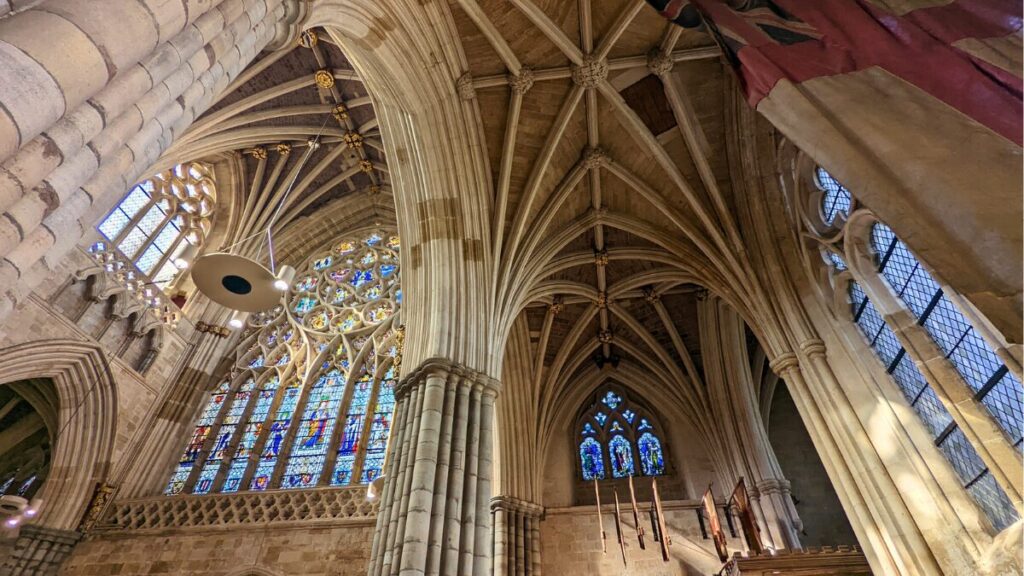
Displaying a thousand-year-old manuscript is a bit of a process!
Light and changing conditions can damage old pages, so the cathedral needed a suitable place to show the Exeter Book and the other objects it holds.
The Treasures Exhibition forms part of Exeter Cathedral’s 2020s Development Appeal, with support from the National Lottery Heritage Fund, the Wolfson Foundation, the Garfield Weston Foundation and the Julia Rausing Trust. That work has given visitors permanent access to objects that were previously difficult to see!
If you’re coming through Exeter by train, the cathedral is in the centre. Check the cathedral’s current admission details and opening hours before you go. I’ve also got a full blog post about Exeter Cathedral here, and here’s my post with things to do in Exeter!